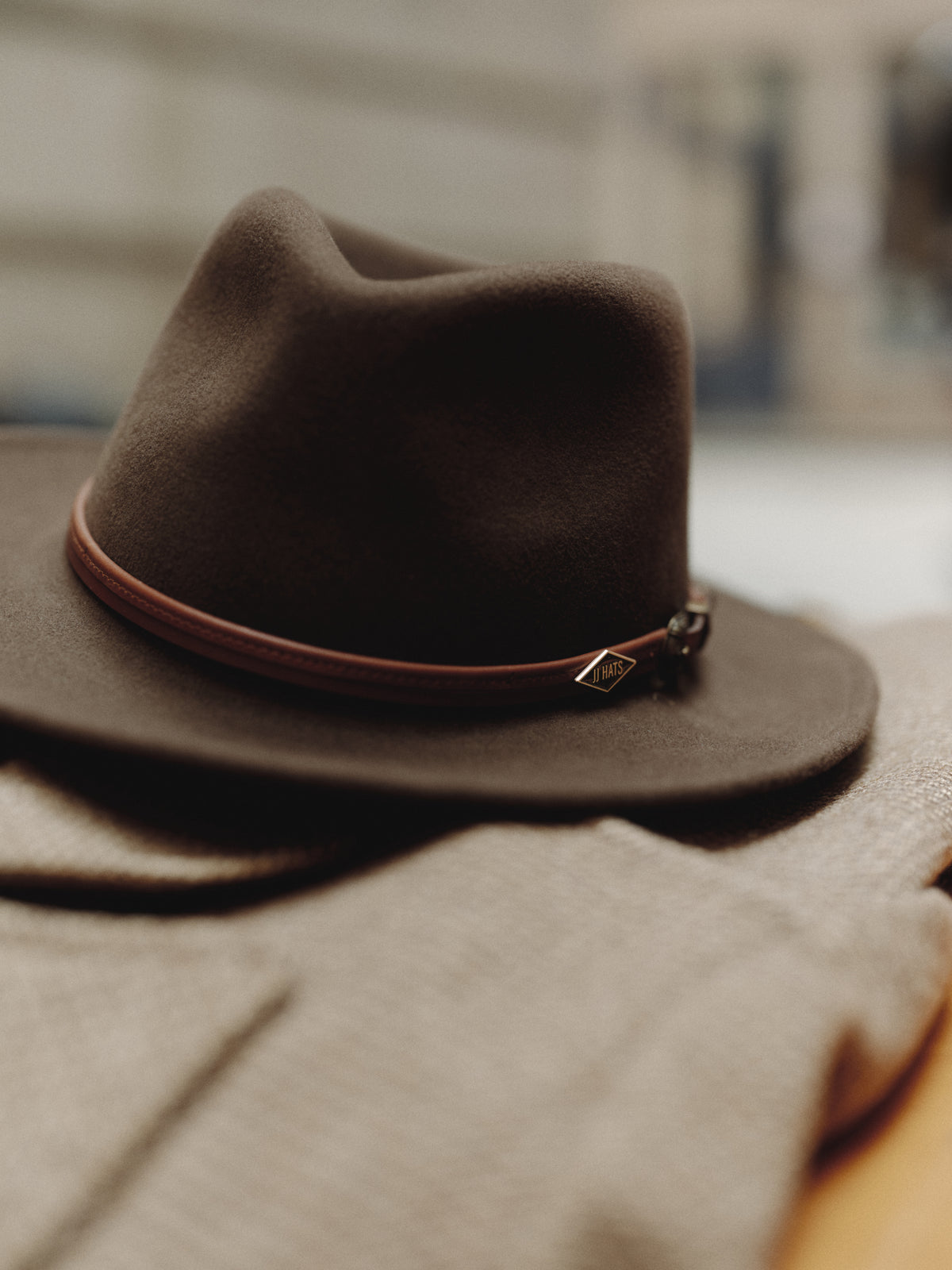
The brim of a hat is the band of material that projects outward from the base of the crown and runs all the way around the hat, shading the face, ears, and neck. It is measured from the crown base to the outer edge, and its width, its set, and the way its edge is finished tell you more about a hat than any other single feature. Change nothing but the brim, and a dress hat becomes a sun hat.
What Is the Brim of a Hat? The Anatomy Behind the Term
Every hat has two structural parts. The crown is the dome that sits over your head; the brim is the flat or curved shelf that extends from the bottom of that dome. The line where they meet is the brim break, and it is the point a hatter measures from. Inside, a sweatband rings the crown base; outside, a ribbon or hatband usually covers the same seam.
Brim width is taken at the side of the hat, straight out from the brim break to the outer edge. Front-to-back figures run long, because brims are often cut a touch wider at the front and rear to balance the face — when a hat is sold as a two-and-a-half-inch brim, that is the side measurement. Two other terms come up constantly in a hat shop: the set of a brim is the position it holds — flat, snapped down, curled up — and the edge finish is how the outer rim is treated, which is where much of a hat's formality is decided.
Brim, bill, or peak — what is the difference?
A brim goes around. A bill or peak projects from the front only. That is why a baseball cap, a flat cap, and a newsboy cap do not have brims in the strict sense, even though people use the word loosely. The distinction matters when you are shopping: a brim shades from every angle and changes the proportion of your whole silhouette, while a peak shades the eyes and nothing else.
What Are Hat Brims Made Of?
A brim can only do what its material allows.
- Fur felt (rabbit, hare, or beaver fur) is the hatter's benchmark. It is dense and fine, and it takes a shape under steam that it then holds for years — which is why almost every brim that can be snapped up or down is made of fur felt. Our felt hats cover this ground; if you want to see how a felt body becomes a shaped brim, our guide on how a premium hat is made walks through blocking and finishing step by step.
- Wool felt is softer in the hand and the more accessible of the two felts. It makes a perfectly good brim, but it is less crisp at the edge and more willing to relax out of its set, especially after rain.
- Straw covers a wide family: hand-woven toquilla palm for Panama hats, shantung and toyo woven from treated paper yarn, raffia, and the stiff sennit braid used for boaters. Straw brims get their firmness from the weave plus a sizing or stiffener, and they are set once — at the block — and never again.
- Cloth brims in tweed, wool flannel, cotton, linen, or canvas are built up with concentric rows of stitching, often over a thin stiffener. The stitching is structural, not decorative: it is what keeps the brim from going limp.
- Leather and oilskin brims belong to outdoor and traveler styles. They take a shape, keep it through weather, and darken attractively with age.
- Wire-edge brims hide a thin wire inside the outer edge, mostly in women's styles and packable hats. The wire lets you bend the brim, flatten it for a suitcase, and bend it back.
Material is also where brand reputations live. Stetson is our best-selling hat brand over the past year — close to two in five hats that leave the shop carry its name, roughly a quarter ahead of the runner-up — and that standing rests largely on fur felt bodies whose brims hold a set. Borsalino, third in the same ranking, is the Italian reference point for a fine felt brim with a hand-finished edge. JJ Hat Center, a New York hat shop since 1911, carries both.
Types of Hat Brims
Brims are described three ways at once: by width, by set, and by edge finish. A single hat carries all three labels — a stingy snap brim with a raw edge, say. The widest selection of the first group sits in our short brim hats collection, and that is where most customers start: width is the decision that drives the other two.
By width: stingy, classic, and wide
- Stingy or short brim — about one and a half to two inches (4 to 5 cm). Sharp, modern, easy to wear in a crowd, and forgiving in the wind. A stingy-brim fur felt fedora is currently among our ten best-selling pieces of the season, which tells you how strongly the city leans short.
- Classic — roughly two and a quarter to two and three-quarter inches (6 to 7 cm). This is the everyday range for a fedora or a trilby: enough brim to read as a proper hat, not enough to crowd your shoulders.
- Wide brim — three inches (about 7.5 cm) and up, rising to four inches and beyond on dress Westerns, sun hats, and women's picture hats. Wide brims make a statement before anyone sees your face, and they are the ones to choose when you want the ears and the back of the neck covered as well.
By set: how the brim is shaped
- Snap brim — firm enough to hold whatever position you put it in, down at the front, up at the back, or flat. The most versatile brim there is, and the reason one hat can look formal on Monday and casual on Saturday.
- Flat set — dead level all the way around, as on a straw boater or a flat-brim Western. Graphic, deliberate, slightly formal.
- Pencil curl — a tight upward roll around the whole edge, the signature of a bowler or derby and of many Western hats. It stiffens the edge as well as shaping it.
- Turned up — sides rolled high, opening the face. Taken to its extreme on Western "taco" shapes.
- Turned down — the whole brim angled toward the shoulders. Softer, more private, excellent in rain.
By edge finish
- Raw or cut edge — the felt is simply trimmed. Clean, contemporary, and the finish that shows the quality of the felt body most honestly, since there is nothing to hide behind.
- Bound edge — a grosgrain ribbon sewn around the rim. The dressiest option, and the most durable: the ribbon takes the abrasion that would otherwise fray the felt.
- Welt edge — the edge turned and stitched, upward for an overwelt, under for an underwelt. A quiet detail that adds body to the rim and reads as handwork.
Western brim shapes
Cowboy hat brim shapes form their own vocabulary, because a Western brim is shaped to work rather than to follow fashion. A cattleman roll turns both sides up in a smooth, even curve. A pencil roll tightens that curl to a narrow bead all the way around. A taco sets the sides high and close, throwing rain and sun off the shoulders. A flat brim stays level, a traditional choice in parts of the Southwest. All of them are set the same way — steam, hands, and a block — and all of them can be re-set by a hatter if the shape drops. If this is your direction, start with our cowboy hats.
How Wide Should a Hat Brim Be?
Three things decide it: your proportions, your purpose, and the formality of what you wear with it.
Proportion first. A brim should read in scale with your shoulders. If it extends past them, it dominates your silhouette; if it looks small against a broad frame, the hat reads like an afterthought. Face shape pulls in the same direction: a fuller, rounder face is balanced by a wider brim and a creased crown, while a long or narrow face is better served by a shorter brim and a lower crown. Our guide to which hat suits your face shape works through the combinations in detail. Height matters too — taller wearers carry three-inch brims comfortably, while shorter wearers usually look best in the two-and-a-quarter to two-and-a-half-inch range.
Then purpose. For sun protection, width is not a style question. The American Academy of Dermatology recommends a brim of at least two to three inches all the way around, with a dark, non-reflective underside to cut the light bouncing up off pavement and water. A stingy brim does not come close to that, and a classic brim only just reaches the lower end of it.
Then formality. Narrower brims with bound edges sit comfortably with tailoring. Wider brims, raw edges, and pronounced curls lean casual, Western, or occasion-wear. A bound two-and-a-half-inch brim is the single most useful thing to own if you want one hat to cover a funeral, a wedding, and a Tuesday.
One practical test before you buy: in the mirror, turn your head to three-quarters rather than facing straight on. A brim that looked right head-on often turns out to be catching your shoulder when you move, and that is the angle everyone else sees you from.
Living With a Brim: Handling, Storage, and Reshaping
The first thing we show a new customer at JJ Hat Center is how to hold a hat: the brim is the part you touch, and the crown is the part you leave alone. Lift a felt hat by the front and back of the brim, never by the pinch of the crown — gripping the pinch is what breaks down a crown over a few seasons. Set the hat down upside down, resting on its crown, so the brim keeps its curl instead of flattening against a table.
Brush the brim on both faces, following the nap in one direction; the hat brush is one of the most-bought accessories in the shop, which is a fair indication of how much of hat care is simply brushing. If a fur felt brim loses its line, pass it through steam a few seconds at a time — a kettle is enough — shape it with both hands, and then leave it crown-down until it is bone dry. Steam only softens the felt; it is the drying that sets the new line, which is why patience matters more than heat. Straw asks for the opposite instinct: support it from underneath, never fold it, and let a hatter re-block it rather than forcing it by hand.
For travel, the brim decides your packing. Soft and wire-edge brims roll; snap brims and bound edges want a hat box or a crown-down spot in your luggage with soft items packed inside the crown, never on top of it.
Frequently Asked Questions
What is the part of a hat that sticks out called?
It is the brim. The brim runs all the way around the hat and projects outward from the base of the crown. If the projection only covers the front, it is not a brim at all but a bill or a peak — the term used for baseball caps, flat caps, and newsboy caps.
How do you measure a hat brim?
Measure at the side of the hat, straight out from the point where the crown meets the brim to the outer edge, with the hat sitting flat. Do not measure from the ribbon, and do not measure front to back: many brims are cut slightly wider at the front and rear, so a front-to-back figure overstates the width.
What is a stingy brim?
A stingy brim is a short brim, roughly one and a half to two inches (about 4 to 5 cm). Stingy-brim fedoras and trilbies read sharp and urban, sit comfortably under a coat collar, and suit narrower frames. They shade the eyes but give little coverage to the ears and neck.
Is a snap brim the same as a short brim?
No. Short brim describes width; snap brim describes how the brim behaves. A snap brim is firm enough to hold a position, so you can wear it turned down at the front and up at the back, or flat all around. Short brims and wide brims can both be snap brims.
Can you reshape a hat brim?
It depends on the material. Fur felt can be re-set with steam and will hold the new line once it dries. Wool felt takes a new shape less willingly and tends to relax back toward its old one. Woven straw will not reshape at all once it is blocked and stiffened — forcing a straw brim cracks the weave, and a cracked brim cannot be repaired invisibly.