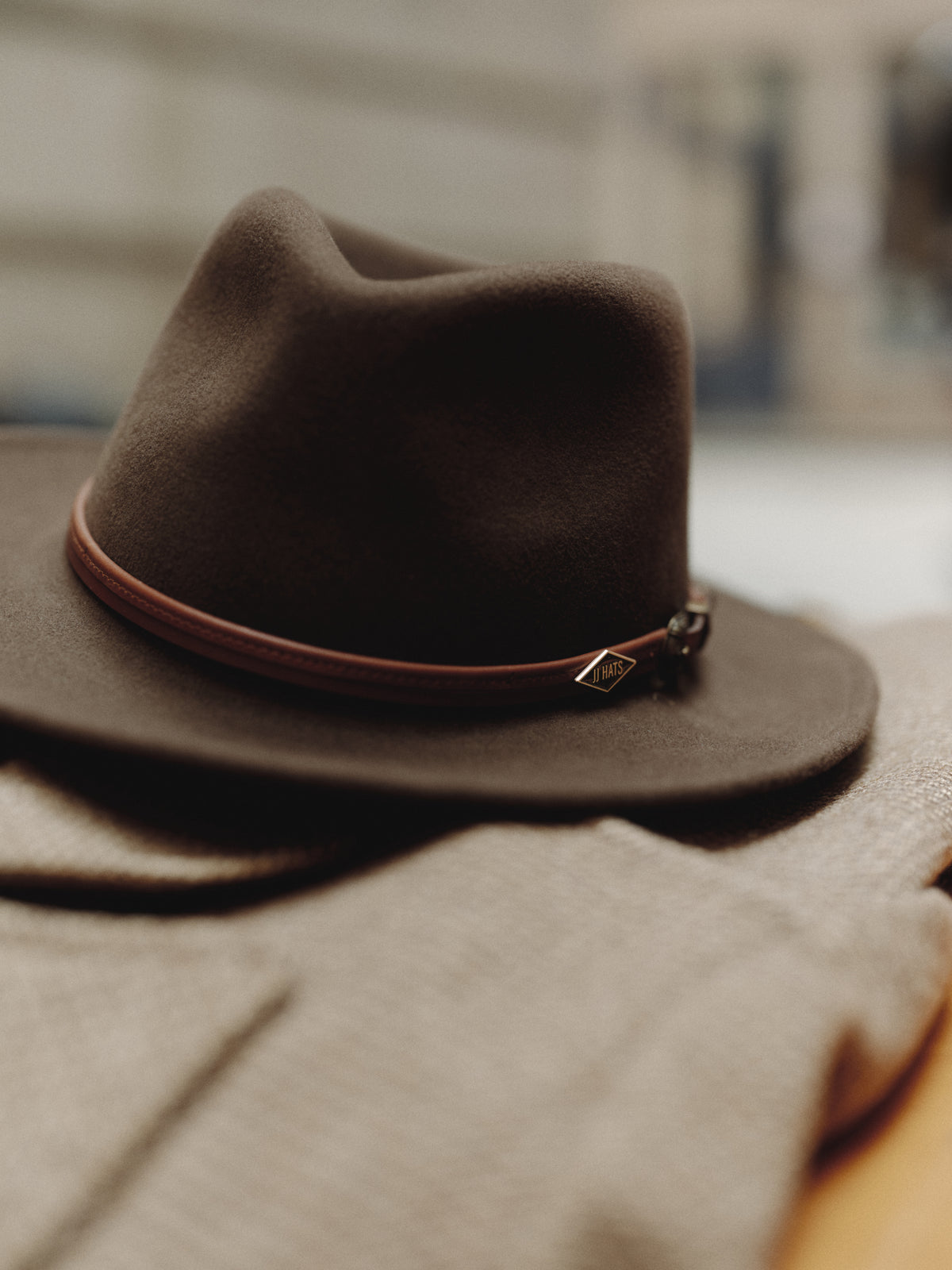
So what are the hats called that cover your ears? Five styles do the job, and each has its own name: the trapper hat (sold in the US as an aviator or bomber hat), the Russian ushanka, the tweed deerstalker, the earflap flat cap or traveller hat, and the cuffed knit beanie. What separates them is not the label but the mechanism: a hinged flap you fold down, a panel hidden inside the lining, or a band of knit you pull over your ears. That mechanism decides how much wind the hat stops and how dressed-up it looks. JJ Hat Center, a New York hat shop since 1911, has fitted all five across more than a century of Northeast winters.
What Are the Hats Called That Cover Your Ears? The Short List
Every style below covers the ears, but they are not interchangeable.
| Name | Also called | How it covers the ears | Best for |
|---|---|---|---|
| Trapper hat | Aviator hat, bomber hat, lumberjack hat | One continuous flap wraps temple to temple; folds up and fastens at the crown | Hard cold, wind, snow |
| Ushanka | Russian fur hat, chapka | Long fur flaps that tie under the chin or over the crown | Deep cold, full-fur look |
| Deerstalker | Sherlock hat | Two flaps that button or tie over the crown, plus front and back bills | Cold rain, country wear |
| Earflap flat cap / traveller hat | Kent cap, earflap newsboy, winter traveller | A panel tucked inside the lining, invisible until you pull it down | City and office wear in winter |
| Beanie | Watch cap, toque, knit hat | No flap: the knit body itself sits over the ears | Mild cold, layering under a hood |
Hats With Flaps Over Your Ears vs. Hats That Simply Cover Them
Hats with flaps over the ears share one advantage: the flap also covers the nape of your neck, which is where most cold air actually reaches you. A flap seals along the jaw and behind the skull, so wind has no path in. Hats without flaps — beanies, fitted knits, fleece-lined caps — cover the ear itself but leave the gap between hat and collar open.
The second difference is reversibility. A flap folds up and fastens, so one hat works on a raw morning and a mild afternoon. A beanie is one temperature, and your only adjustment is how far you pull it down.
The Trapper Hat: The American Name for the Earflap Classic
A trapper hat is the style most Americans picture when they ask about a hat with flaps. The construction is specific: a domed crown, a short front visor on many models, and a single continuous flap band that runs from one temple, around the back of the head, to the other temple. Fold it up and it snaps or buttons across the front of the crown; fold it down and the hat covers ears, nape, and part of the cheeks in one move. Better versions add a chin cord so the hat stays put in wind.
The same hat is sold under three other names. Aviator hat comes from the leather-and-fleece helmets of open-cockpit flying, bomber hat from the crews who wore shearling-lined versions at altitude, and lumberjack hat from the wool-shell versions worn in North American logging country. If a listing uses any of those words, you are looking at a trapper.
Shells are usually wool melton, waxed cotton, or leather; linings run from shearling and lambs fur to rabbit and technical pile. What matters is whether the flap is lined on both faces, whether the fastener holds under a scarf, and whether the crown is deep enough to sit below your hairline — the details our guide on what to look for in a good trapper hat works through in order. For the current selection, see our trapper hats.
This is not a niche category for us. Beanies and trapper hats together rank third among the product types we sell across the past year — roughly one in nine pieces that leaves the shop.
What Is the Difference Between a Trapper Hat and an Ushanka?
The difference between a trapper hat and an ushanka is the shell. An ushanka — from the Russian ushi, meaning ears — is fur inside and out: sheepskin, rabbit, muskrat, or mink on the visible surface as well as the lining. A trapper hat uses a textile or leather shell with fur or pile only on the inside and the flap faces.
Three practical consequences follow from that one difference:
- Closure. An ushanka's flaps are long and finished with cords or ribbons, so they tie under the chin or fold up and tie above the crown. A trapper's flap is short and uses a snap or button.
- Weight and warmth. Full fur on both faces is warmer and noticeably heavier. An ushanka is built for cold that stays below freezing for months; a trapper is built for a cold commute.
- How it reads. In an American city, a full-fur ushanka is a statement; a wool-shell trapper is simply a winter hat. If you want the fur look without the costume, our fur hats cover that ground, and the broader winter headwear selection sits between the two.
One term to ignore: chapka. It is the French word for the same Russian hat, and sellers use it interchangeably with ushanka.
The Deerstalker: Tweed With Two Sets of Flaps
A deerstalker is the only hat on this list with four coverage points. It has a bill at the front and a bill at the back, plus two separate ear flaps that tie or button together over the crown when not in use. It was made for Scottish deer stalking: the rear bill sheds rain down your collar instead of your neck, and the flaps come down when the wind turns.
The tweed itself does real work. A tightly woven wool tweed holds its shape when wet, sheds a light rain, and keeps insulating when damp — the reason the style never moved to cotton. Its association with Sherlock Holmes came from illustration rather than the stories, which is why in the US it reads as a deliberate, country-weekend choice rather than a default winter hat.
A Hat With Ear Covers You Can Wear to the Office
If you want a hat with ear covers that does not announce itself, the answer is a flat cap or a traveller hat with a concealed flap. The panel is stitched into the lining and folds up inside the cap body, so from the outside the hat looks like any other wool flat cap. Pull the panel down and it covers both ears and the nape; tuck it back and you can keep the hat on indoors.
This is the quietest solution to the problem, and our customers vote for it with their orders: a wool flat cap with ear flaps has been our second-best-selling item overall across the past year, and a wool traveller hat with ear flaps sits inside our top five. Caps are also the single largest product type we sell, just ahead of brimmed hats.
Two things separate a good concealed flap from a bad one. First, the panel must be cut wide enough to reach the jaw — a short flap covers the ear but not the gap behind it. Second, the lining has to hold the panel flat when it is tucked up, or the cap develops a ridge across the forehead. Both are matters of pattern cutting rather than material, which is why they tend to track price: it is in our premium cap selection that both details become reliable.
A traveller hat does the same job with a brim instead of a peak. Because the brim shades the eyes and sheds rain, it is the better pick if you walk a lot in sleet; the flat cap is the better pick under a car roof or a subway ceiling.
Beanies and Watch Caps: Coverage Without a Flap
A beanie covers your ears with nothing but knit, and the fold is what makes it work. A cuffed beanie — the US Navy watch cap is the pattern everyone copies — turns the brim up so the band over your ears is two layers thick instead of one. That doubled band is the warmest part of the hat, and it is the only part engineered for your ears.
Fiber matters more here than in any other style, because the knit sits directly against skin for hours. Merino and lambswool insulate while staying breathable; cashmere is softer and lighter for the same warmth; acrylic holds heat but traps moisture, which is what makes cheap beanies itch and then clam up. Our wool beanies and the combined beanies and trapper hats selection are organized along exactly that split.
A warning about slouch and oversize beanies: the extra length is behind your head, not over your ears. Worn as styled, many of them sit above the ear entirely. If ear coverage is the point, check that the cuff still lands below the earlobe when the hat is on.
Are Earflap Hats Warmer Than Beanies?
Yes — earflap hats are warmer than beanies in cold that moves. Three reasons, in order of how much they matter:
- Wind. Knit is porous by construction; a woven or leather shell is not. On a gusty day, a beanie loses heat through the fabric while a trapper's shell stops the air entirely.
- Layers. An earflap hat is a shell plus insulation plus a lining. A beanie is one knit layer, or two across the cuff.
- Seal. Flaps press along the jaw and behind the skull and close the gap to your collar. A beanie ends at the ear and leaves that gap open.
The beanie wins on three counts of its own, and they are not trivial: it packs into a coat pocket, it fits under a hood or a helmet, and it vents enough heat that you can keep it on while walking fast. A fine merino beanie is the better hat on a dry day in the forties; the moment it is windy, wet, or below freezing, ear flaps are the better hat.
Wool, Shearling, or Fur: Matching the Material to the Cold
Earflap styles are built from four material families, and each has a job:
- Wool melton shell. Dense, wind-resistant, holds its shape, sheds a light rain. The default for city trapper hats and earflap caps.
- Shearling or lambs fur lining. The warmest insulation per ounce, and the reason bomber-style hats work at altitude. It adds bulk, so expect a larger silhouette.
- Fur felt. The shell material of better traveller hats — rabbit or beaver felt is water-repellent by nature and keeps a brim crisp through a wet day.
- Waxed cotton and leather. The most weatherproof and the stiffest. Choose it for sleet, not for comfort straight out of the box.
On brands, the pattern in our own sales is clear: Stetson has been our best-selling brand across the past year, with Lierys close behind it, and Borsalino leading the Italian felt side. If you are shopping the heavier wool-shell end of the category, our overview of brands that sell high-end lumberjack hats with ear flaps compares the makers directly.
How an Earflap Hat Should Fit
Measure before you choose a size. Run a soft tape around your head so it crosses the middle of your forehead and passes just above your ears, and keep it level. That measurement maps to US hat sizes, which run roughly from 6 7/8 through 7 3/4 in standard production, with S/M/L sizing used on knit and on many trapper styles.
Two fitting rules are specific to hats with flaps:
- A concealed flap takes up room. On a flat cap or traveller hat, the panel folds up inside the cap, so the hat sits tighter with the flap stowed than the size chart suggests. If you are between sizes, take the larger one.
- A structured trapper does not stretch. Knit gives; a lined wool or leather crown does not. It should sit below your hairline with no pressure line across the forehead, and the flaps should meet your jaw without pulling the crown down over your brow.
If a hat arrives slightly tight across the brow, a hatter can stretch a felt or wool crown a fraction. A knit beanie and a fur-lined flap cannot be altered, so size those correctly the first time.
Frequently Asked Questions
What do you call a winter hat with ear flaps and a chin strap?
That is an aviator or bomber hat — both names describe a trapper hat whose flaps fasten under the chin with a cord or strap rather than snapping up at the crown. The strap exists for wind, not warmth.
Do you have to wear the ear flaps down?
No. Every flap style is designed to be worn up and fastened, which is how most people wear a trapper hat in town. Worn up, the hat is roughly as warm as a lined cap; the flaps are there for the days you need them.
Can a flat cap cover your ears?
Only if it is built for it. A standard flat cap stops above the ear. An earflap flat cap, often sold as a Kent cap, has a panel folded into the lining that pulls down over both ears and the nape, and it looks identical to a plain cap when stowed.
What hat covers your ears and still looks formal?
A wool or fur felt traveller hat with a concealed flap. It keeps a brim and a clean crown line, so it works with a topcoat in a way no trapper hat does, and the flap disappears the moment you fold it back in.
How cold does it need to be before you need a fur-lined hat?
As a rule of thumb, a wool shell with a pile lining covers you down to around freezing. Below that — or in wind, which matters more than the thermometer — a shearling or fur lining is what keeps your ears comfortable rather than merely covered.